
Opening our 12th program CAVES is pleased to present an exhibition of new works by;
Beth Arnold, Fernanda Ureta, Lani Knezevic.
one septillion stars is an exhibition premised on the search for a language. A language that could communicate with extraterrestrial life. Although at first appearing to be an outward gesture, it becomes clear that this question acts like a mirror upon ourselves. In seeking a language adequate for the extraterrestrial, we begin to divulge fragments of our lived humanity.
Artists Lani Knezevic, Fernanda Ureta and Beth Arnold consider what shape this language may take. Their
works exhibit nostalgia, cultural and political identities and the lived architecture of space. These ideas become vessels that shape this unknowable language. These works grasp at the possibility of communicating with extraterrestrial life, exposing its impossibility. And, in doing so, reflect back upon themselves as an expression of their humanity.
In 1999, astronomers Yvan Dutil and Stépahne Dumas sent a series of telegrams into the cosmos from Ukraine’s Yevpatoria RT-70 radio telescope. Their telegrams sought to communicate with extraterrestrial life using Lincos, a language constructed from sequences of repeating and pausing pulses. These telegrams are said to arrive sometime around 2035. As a dialogue, their effort is impractical. Dumas admits this — the unlikelihood of reply, the absence of exchange. Instead, their effort raises questions about how we communicate with the other and how we would depict ourselves to the other. Dutil and Dumas considered their work a dialogue amongst ourselves, like mirrors held up to humanity. In much the same way, one septillion stars exhibits this reflection.
one septillion stars emphasises the individual. The individual is what emerges when we begin to question the
unknown. The individual is nostalgic, resists the force of global powers, is embodied, and exists in an oscillating
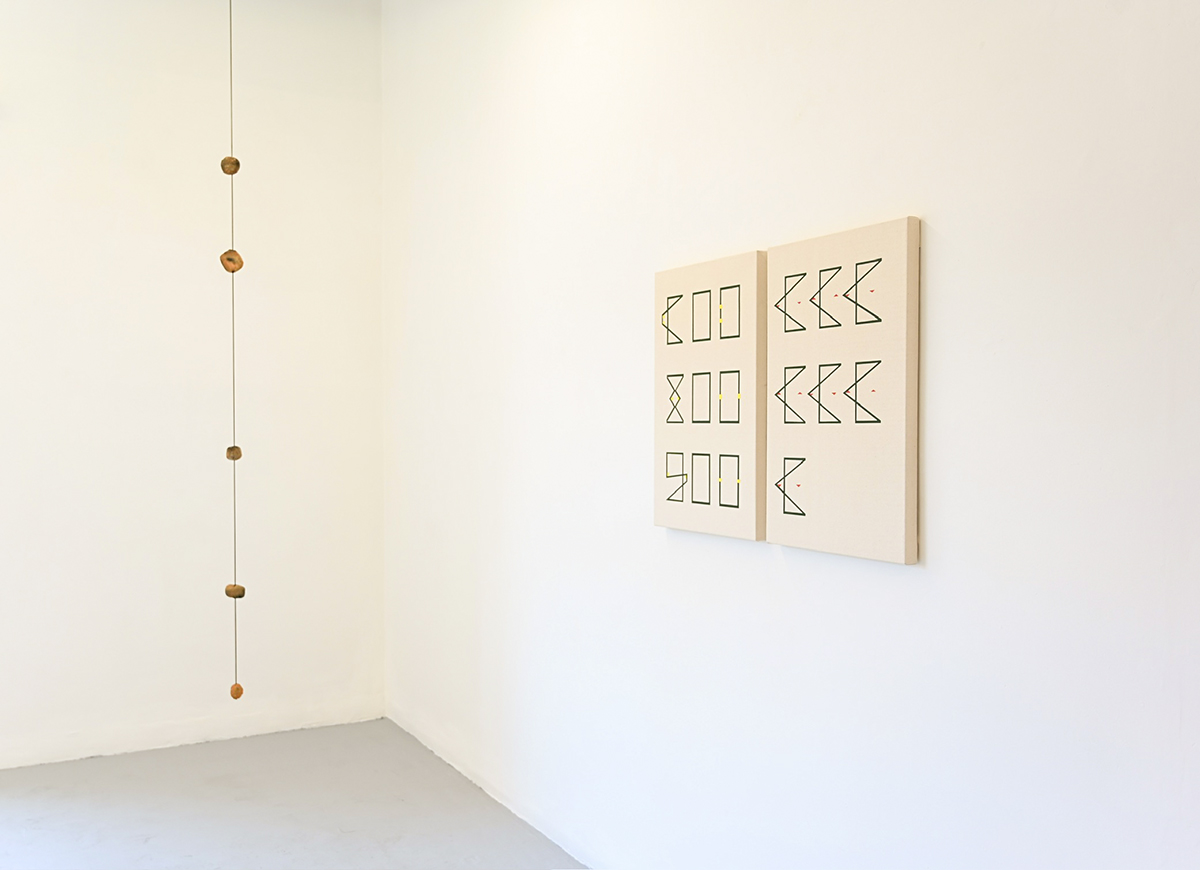
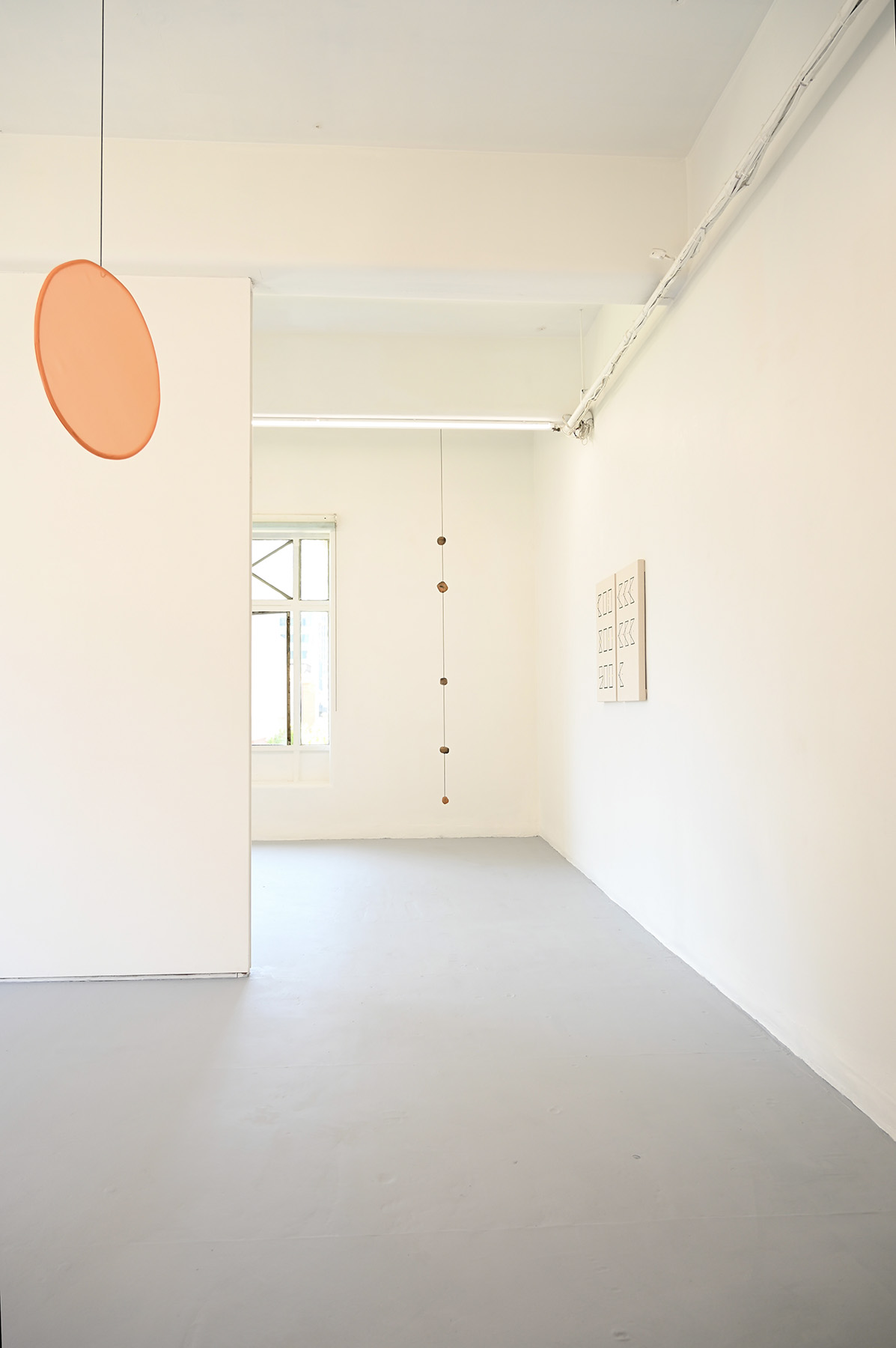
relationship with space. Lani Knezevic’s gesture towards nostalgia assumes that the extraterrestrial could hold memories. Knezevic locates nostalgia in the form of a Chinese rope game that the artist played as a child. Therules communicated outward reflect back a memory and emotion that become a fundamental fragment of an earthly existence. Beth Arnold’s spherical ochre reflections assume the extraterrestrial has a body moving in space. The passing reflection of the sunlit stains engages the body in the material earthly condition. These works assume the human-like shape of extraterrestrial life and communicate through uniquely humane forms.
Fernanda Ureta’s electromagnetic wave is rooted in raw materials, from which they reach outwards towards the unknown. As Ureta herself writes, “it is in the bridge between me and everything-else that new narratives, forms of communication, popular as well as individual imaginaries of the surrounding world arise.” These works reveal how a dialogue with the other inverts to become a dialogue amongst ourselves.
one septillion stars, and Ureta’s correspondence in particular, brings to mind a quote by the author Anne Carson.
In her dissertation, Eros the Bittersweet, she writes, “each one of us is but the symbolon of a human being —
sliced in half like a flatfish, two instead of one — and each pursues a never-ending search for the symbolon of
himself.” The ritual of seeking communication with extraterrestrial life is an extension into the unknown. It is a
reaching towards the other. Towards our symbolon. It is a ritual that reflects the undiscovered other within
ourselves. It is in the process of reaching for the unknown that a sharper vision of ourselves is rendered.
Dumas asked, “What do we want to give ET - the truth, or a beautiful image?” But could the truth be a beautiful image? Knezevic, Ureta and Arnold have shown how the fragmented conditions of humanity emerge when we seek to translate ourselves. These conditions reveal themselves to be complicated, but beautiful and truthful.
What becomes clear is how this ritual of searching for a language unveils the gaps in our own language. Much like Dutil and Dumas explored through their telegram messages, one septillion stars is a process for self-recognition.
Text By Georgia Puiatti
Through the framework of a sculptural practice, Beth Arnold works with and responds to sites. A continuing focus of her practice has been developing an expanded understanding of site, where context is crucial and site is positioned as a shifting environment of multiple relations. The sites she is responding to are situated in the construct of the everyday and explore the complexities of the built environment. Arnold’s work considers relationships of temporality, narratives, and intimacy within space. Often subtle in nature, works are generated in the form of installations, performance, and photography.
Fernanda Ureta is interested in each of her works being a symbol of the hard individual resistance to any global power, so she uses common materials to make way for the ambiguous space between what is her own and that other unknown to which she wishes to give light. As a result, her works have in common an unfinished desire for perpendicularity in their structures and a particularity that seeks to reach something out of reach; it is in the bridge between the artist and everything-else that new narratives, forms of communication, and popular as well as individual imaginaries of the surrounding world arise.
Lani Knezevic is an Australian born, Croatian raised artist exploring themes of memory, belonging and (un)belonging. Inspired by the personal and the mundane, they question what it means to be human, to occupy a body – to be a body - through an immaterial practice of video, text and sound.